verified
Evidence Auditor
Checking faithfulness to raw source
$ audit --layer=evidence --batch=0f21span#0142 offset match ......... okparaphrase drift 0.00 ......... okmodality preserved ............ ok→ 412/412 spans faithful
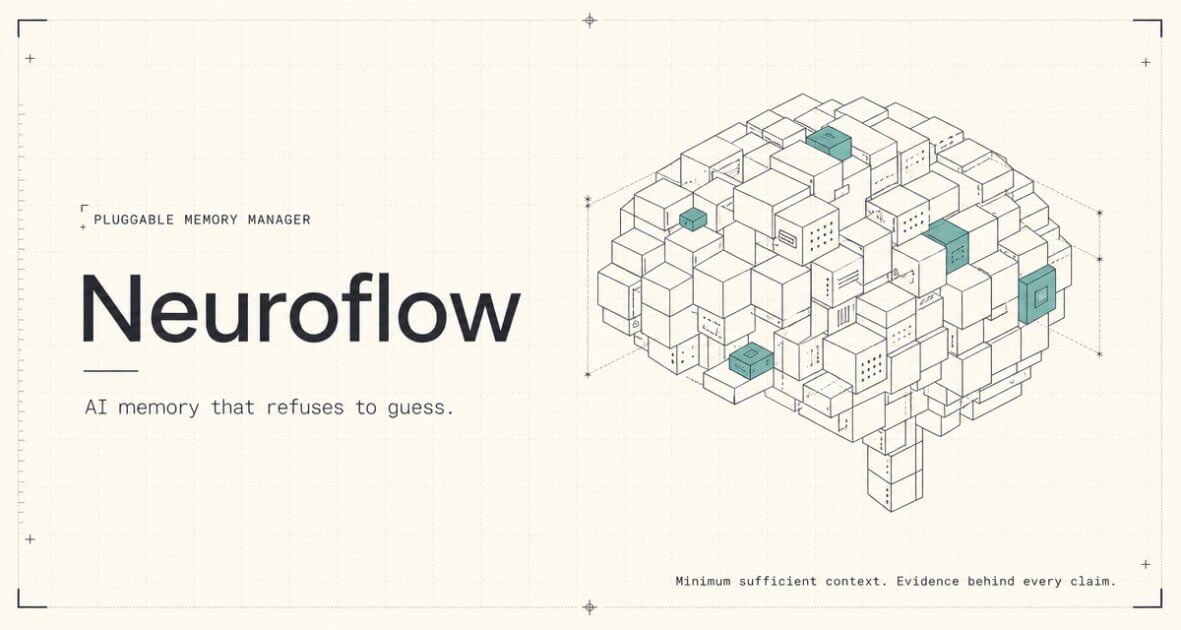
pluggable memory manager for AI systems
Minimum sufficient context. Evidence behind every claim.
retrieval spine · descending to source truth
01 / minimum sufficient retrieval
Most AI memory systems either forget too much or retrieve too much. Neuroflow uses progressive retrieval: it starts with the smallest relevant memory object and descends toward evidence or raw source only when the task requires it.
One atomic claim: Q3 butter volume of ~3,000 MT is indicative only; no firm commitment exists.
default to minimal context. expand only when needed.
02 / failure analysis
question
“Has Milky Way Co. committed to 3,000 MT of butter for Q3?”
“Yes — Milky Way Co. has committed to 3,000 MT of butter for Q3 at the agreed price.”
“No — the source says the volumes are indicative, not firm.”
why it matters · Neuroflow preserves modality, evidence and source traceability, so a hedged statement can never harden into a commitment on the way into memory.
03 / memory architecture
summary
orientation only
evidence
citable
raw source
final authority
Summaries help the system navigate. They are not evidence and cannot prove a claim. When a claim matters, Neuroflow descends to evidence and raw source.
Atomic, evidence-backed, and independently updateable. A neuron carries one claim and the evidence that earns it.
04 / retrieval controller
For every task the controller chooses an expansion depth — from no memory at all to raw source — then applies policy, sensitivity rules, expansion limits and audit requirements before returning a context bundle.
controller inputs
memory map is structure. the controller is runtime.
05 / memory lifecycle
ingest
Documents hashed, versioned, stored immutably. No interpretation at this stage.
extract
Verbatim spans lifted with source offsets and a faithfulness score.
atomise
Each span becomes at most one neuron carrying exactly one claim.
assemble
Neurons grouped into nuclei shaped by the questions the business asks.
audit
Auditor agents admit, split, or reject before anything becomes retrievable.
revise
New evidence supersedes old neurons; history is retained, never overwritten.

fig. 04 · layer assembly
06 / memory firewall
Neuroflow does not rely on model opinion to decide whether memory is safe. Guardrails are deterministic checks with fixed verdicts and logged reasons.

fig. 03 · rejection gate
07 / auditor agents
Nothing enters memory unaudited. Each layer has a dedicated auditor with the authority to reject.
Checking faithfulness to raw source
$ audit --layer=evidence --batch=0f21span#0142 offset match ......... okparaphrase drift 0.00 ......... okmodality preserved ............ ok→ 412/412 spans faithful
Validating safety and evidence backing
$ audit --layer=neurons --strictclaims without evidence ....... 0multi-claim neurons ........... 0unsafe generalisation ......... 0→ 212/212 neurons admitted
Judging semantic coherence
$ audit --layer=nuclei --coherencecross-topic contamination ..... 0coherence score ............... 0.94orphan neurons reassigned ..... 3→ 14/14 nuclei coherent
08 / case study
Three emails. Hover a message to follow the chain of custody: evidence extracted, neuron created, nucleus assigned.
Q3 butter — indicative volumes
“We’re looking at roughly 3,000 MT, but treat these as indicative, not firm.”
RE: Q3 butter — pricing window
“We can hold $4,820/MT until 30 April, after that we re-quote against GDT.”
Board review timing
“Any commitment needs board sign-off, which is scheduled for mid-May.”
evidence
“treat these as indicative, not firm”
neuron
Q3 butter volume of ~3,000 MT is indicative only; no firm commitment exists.
nucleus
Pricing & Commercial Position
09 / pluggable access
Neuroflow returns a context bundle, not a pile of chunks: the minimum sufficient text, the trace that proves it, the expansion depth used, and a verdict.

fig. 05 · inspection surface
GET /neurons?nucleus=…Every response ships with evidence spans and source ids.
neuroflow.retrieveAgent-native access with the same guardrails applied.
human admit / rejectAuditor verdicts are reviewable and reversible by an operator.
what an AI app receives
10 / operating profiles
Neuroflow brains are initialised with an operating profile. A legal memory brain, a writing memory brain, a research brain and an industrial telemetry brain should not form the same neurons. The profile declares what matters, what counts as evidence, what must be retrieved fast, and what must never be inferred.
legal brain
what matters: clauses, obligations, modality
hard rule: never infer intent
writing brain
what matters: voice, decisions, prior drafts
hard rule: never invent a source
research brain
what matters: findings, methods, citations
hard rule: never merge studies
telemetry brain
what matters: thresholds, events, deltas
hard rule: never smooth anomalies
The plugin is general. The brain is specialised.
a memory layer for AI applications
The host application owns the workflow. Neuroflow owns evidence-backed memory, retrieval policy, audit trace and progressive expansion.
11 / positioning
Vectors help Neuroflow find candidates. They do not decide truth. Truth lives in the evidence chain: raw source → source span → evidence item → neuron → retrieval trace.
12 / operating principles

fig. 01 · ingest line
13 / questions
14 / definition
It preserves raw sources, extracts atomic evidence, builds durable memory objects, applies guardrails, and retrieves the minimum sufficient context for each task. It is designed for systems where a missing memory is acceptable, but a false memory is toxic.